eBook Conversion Services | Professional eBook Formatting
Get professional eBook conversion services for EPUB, PDF, Word, and digital publishing formats. High-quality formatting for authors and publishers.
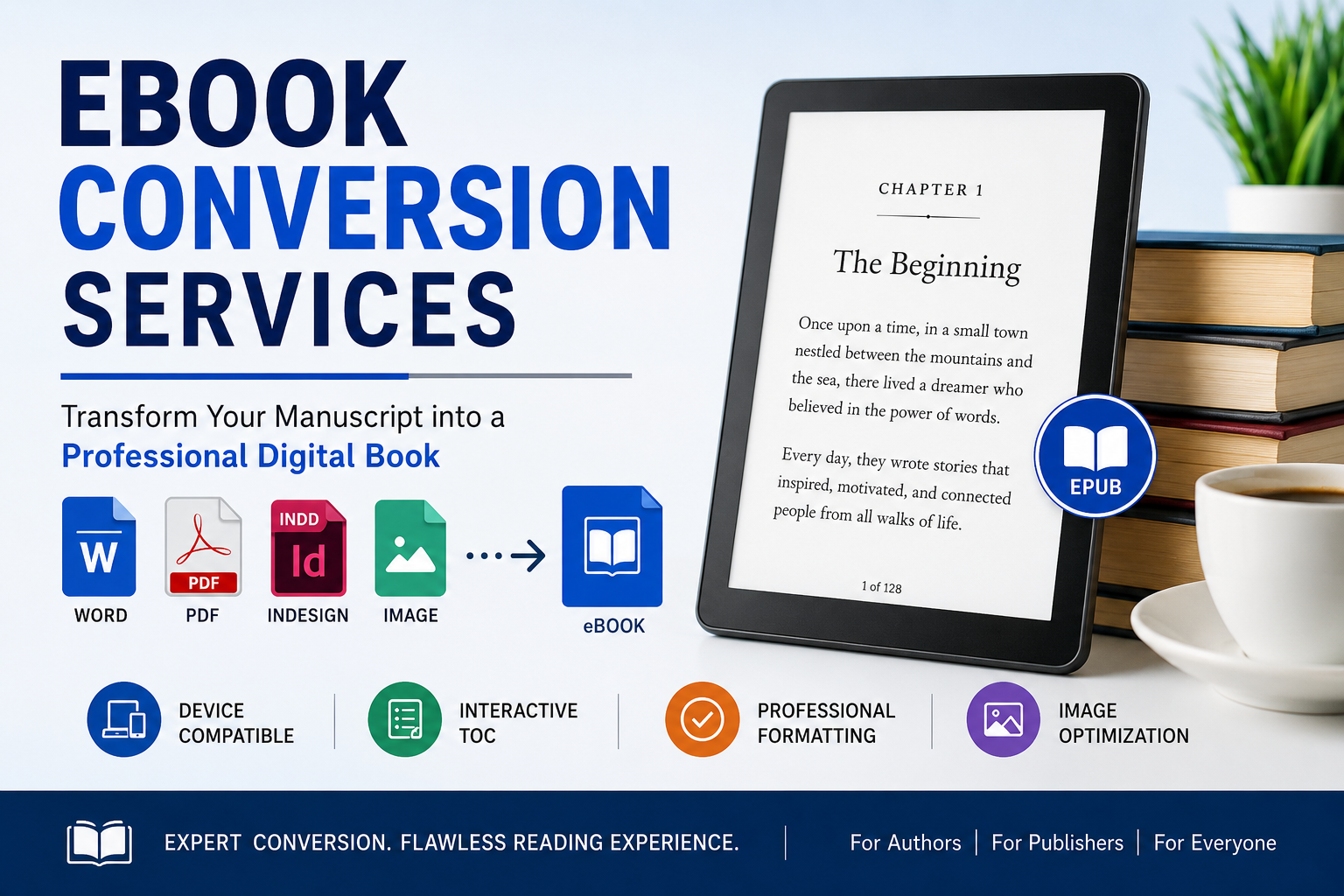
The publishing industry has changed dramatically over the past decade, with digital books becoming an essential part of how readers discover and consume content. Authors, publishers, educational institutions, businesses, and independent content creators are increasingly choosing professional eBook conversion services to transform manuscripts and printed books into high-quality digital formats. A professionally converted eBook offers better readability, wider distribution opportunities, and compatibility across popular e-reading devices and platforms.
Whether you have a manuscript in Microsoft Word, PDF, InDesign, or another source format, professional eBook conversion can turn your content into a structured, responsive, and reader-friendly digital publication. The process involves much more than simply converting one file format into another. It requires careful formatting, coding, quality testing, metadata preparation, and device compatibility checks.
What Are eBook Conversion Services?
eBook conversion services involve transforming manuscripts, documents, or print-ready files into digital book formats designed for electronic reading devices and applications. The goal is to ensure that the book displays correctly across smartphones, tablets, computers, and dedicated e-readers.
A professional conversion process preserves the structure of the original content while optimizing it for digital consumption. Headings, paragraphs, images, chapter breaks, hyperlinks, footnotes, tables, and navigation elements must be properly formatted to create a smooth reading experience.
Unlike a standard PDF, a professionally formatted eBook can adapt to different screen sizes and reader preferences. Readers may be able to change font size, line spacing, margins, and display settings depending on the eBook format and reading application.
Why Professional eBook Conversion Is Important
Publishing a poorly formatted eBook can negatively affect the reader experience and damage an author’s professional image. Common problems include broken paragraphs, inconsistent fonts, missing images, incorrect chapter breaks, navigation errors, and awkward spacing.
Professional eBook conversion services help eliminate these issues by creating clean and technically optimized digital files. Every element of the manuscript is reviewed and formatted according to the requirements of digital publishing platforms.
A properly converted eBook also improves accessibility and usability. Readers expect digital books to load quickly, navigate smoothly, and display consistently across multiple devices. Professional conversion helps meet these expectations.
Popular eBook Conversion Formats
One of the most widely used digital publishing formats is EPUB. EPUB is designed to support flexible and responsive reading experiences across a broad range of devices and applications. It is commonly used by online bookstores, digital libraries, publishers, and reading platforms.
Reflowable EPUB is ideal for novels, biographies, business books, self-help books, and other text-focused publications. The content automatically adjusts according to screen size and reader preferences.
Fixed-layout EPUB is more suitable for visually complex publications where the exact positioning of text and images is important. Children’s books, illustrated books, comics, educational materials, and design-heavy publications may require fixed-layout conversion.
Professional conversion providers may also prepare additional digital formats depending on the distribution platform, project specifications, and publishing requirements.
Word to eBook Conversion Services
Many authors write their manuscripts using Microsoft Word. However, uploading a raw Word document directly to a publishing platform may lead to inconsistent formatting.
Professional Word to eBook conversion services clean and restructure the manuscript before creating the final digital file. This process may include standardizing headings, correcting paragraph styles, formatting chapter titles, inserting page breaks, optimizing images, creating navigation, and removing unnecessary formatting code.
The result is a cleaner and more reliable eBook that performs better across different reading environments.
PDF to eBook Conversion Services
Converting PDF files into eBooks can be more complex because PDF is primarily designed to preserve a fixed page layout. Text, images, columns, tables, and other elements may need to be carefully extracted and reconstructed.
Professional PDF to eBook conversion services help transform static documents into flexible digital publications. Depending on the complexity of the original PDF, the conversion process may involve text extraction, OCR, manual formatting, image optimization, structural coding, and extensive quality checks.
This service is particularly useful for publishers and authors who have older books available only as print-ready PDF files.
Print Book to eBook Conversion
Authors and publishing companies often have books that were originally created only for print. Converting these titles into digital formats can open new distribution opportunities and help reach readers worldwide.
Print book to eBook conversion may begin with the original source file, a PDF, or scanned pages. If only a physical copy is available, OCR technology can be used to extract the text. The extracted content must then be reviewed, corrected, formatted, and structured for digital publishing.
Professional quality control is especially important in OCR-based projects because automated text recognition can introduce spelling errors, incorrect characters, and formatting problems.
Reflowable eBook Conversion Services
Reflowable eBooks are designed to automatically adjust content according to the reader’s device and settings. This makes them ideal for publications that primarily contain text.
Novels, poetry books, business publications, academic content, biographies, and self-help books often work well in reflowable formats. Readers can typically customize font size and other display preferences, making the content easier to read across different screen sizes.
Professional reflowable eBook conversion focuses on semantic structure, clean formatting, logical chapter organization, image placement, and functional navigation.
Fixed-Layout eBook Conversion Services
Some books require precise visual positioning that cannot be achieved effectively through a standard reflowable format. Fixed-layout eBook conversion preserves the relationship between text, images, and page design.
This approach is commonly used for children’s books, illustrated publications, photography books, educational materials, comics, cookbooks, and visually rich content.
Fixed-layout conversion requires specialized expertise because the final publication must maintain visual consistency while functioning correctly on supported devices and applications.
eBook Formatting and Design
Professional eBook formatting is a critical part of the conversion process. A well-formatted digital book should have consistent chapter headings, readable paragraphs, appropriate spacing, properly positioned images, and a logical content hierarchy.
Formatting also involves removing unnecessary styles and correcting hidden code that may cause display problems. Clean formatting improves both the appearance and technical reliability of the eBook.
The objective is to create a professional digital publication that reflects the quality of the author’s content and brand.
Interactive Table of Contents and Navigation
Easy navigation is one of the most important features of a professional eBook. Readers should be able to move between chapters and major sections without difficulty.
An interactive table of contents provides clickable links to different parts of the book. Depending on the format and platform requirements, additional navigation structures may also be created to improve accessibility and usability.
Professional eBook conversion ensures that chapter links, internal references, and navigation elements function correctly before publication.
Image Optimization for eBooks
Images can significantly increase eBook file size and create compatibility problems if they are not properly optimized. Professional conversion services resize and compress images while maintaining suitable visual quality.
Image placement must also be carefully managed. Captions, illustrations, charts, photographs, and graphics should display correctly without disrupting the reading experience.
For image-heavy books, the conversion strategy must consider both visual quality and technical performance.
eBook Conversion for Authors and Self-Publishers
Independent authors can benefit significantly from professional eBook conversion services. Self-publishing provides greater control over pricing, distribution, branding, and publishing timelines, but technical formatting remains a major challenge for many writers.
A professional conversion service allows authors to focus on writing and promotion while specialists handle the technical preparation of the digital book.
This is particularly valuable for debut authors who may not be familiar with EPUB structure, formatting standards, metadata, navigation, and platform-specific requirements.
eBook Conversion for Publishing Companies
Publishing houses often need to convert large catalogs of books into digital formats. Professional conversion services can support both individual titles and bulk conversion projects.
Publishers may require standardized formatting, consistent metadata, quality assurance procedures, image processing, accessibility improvements, and compatibility testing. A structured conversion workflow helps maintain consistency across multiple titles.
Digitizing backlist titles can also create new revenue opportunities by making older publications available to modern digital audiences.
Quality Assurance in eBook Conversion
Quality assurance is one of the most important stages of professional eBook production. The final file should be tested for structural, visual, and functional problems.
Testing may include checking chapter navigation, hyperlinks, images, headings, paragraph formatting, special characters, metadata, and overall display behavior. The eBook should also be reviewed across relevant reading environments whenever possible.
Thorough testing reduces the risk of negative reader reviews caused by technical formatting problems.
How to Choose the Best eBook Conversion Services
Choosing the right eBook conversion company requires careful evaluation of technical expertise, publishing knowledge, quality control procedures, turnaround time, and customer support.
A reliable service provider should understand different source formats, EPUB production, reflowable and fixed-layout conversion, image optimization, navigation, metadata, and platform compatibility.
Authors and publishers should also look for transparent communication and a clear revision process. The cheapest conversion option may not always provide the best results, particularly for complex manuscripts.
Cost of eBook Conversion Services
The cost of eBook conversion depends on several factors, including manuscript length, source file quality, number of images, tables, footnotes, mathematical equations, layout complexity, and required output format.
A simple text-based novel is generally easier to convert than an illustrated educational book or a complex academic publication. Fixed-layout eBooks may also require more technical work than standard reflowable publications.
For an accurate quotation, authors should provide the source manuscript and explain their publishing requirements before the project begins.
Benefits of Outsourcing eBook Conversion
Outsourcing eBook conversion allows authors and publishers to access specialized technical expertise without managing complex formatting and coding internally.
Professional providers can handle file preparation, formatting, structural organization, navigation, image optimization, testing, and final quality assurance. This can save significant time while reducing technical errors.
For publishing companies managing multiple titles, outsourcing can also improve workflow efficiency and scalability.
The Future of Digital Publishing and eBook Conversion
Digital publishing continues to evolve as readers increasingly consume content across smartphones, tablets, computers, and dedicated e-reading devices. Authors and publishers need flexible digital strategies that make content accessible across multiple channels.
Professional eBook conversion services play an important role in this ecosystem by transforming traditional manuscripts and print publications into modern digital assets.
As accessibility standards, reading technologies, and distribution platforms continue to develop, technically structured and professionally tested eBooks will become even more important.
Conclusion
Professional eBook conversion services help authors, publishers, businesses, and educational organizations transform manuscripts and printed content into high-quality digital publications. From Word to EPUB conversion and PDF to eBook conversion to reflowable and fixed-layout production, expert conversion ensures better readability, navigation, compatibility, and presentation.
A professionally converted eBook is more than a digital copy of a printed book. It is a carefully structured publication designed for modern reading environments. By investing in expert formatting, clean technical structure, image optimization, interactive navigation, and quality assurance, authors and publishers can deliver a better reading experience and expand their reach in the global digital publishing market.