How Book Distribution Works: Complete Guide for Authors
Learn how book distribution works, including distributors, wholesalers, bookstores, online retailers, print-on-demand, eBooks, and global distribution.
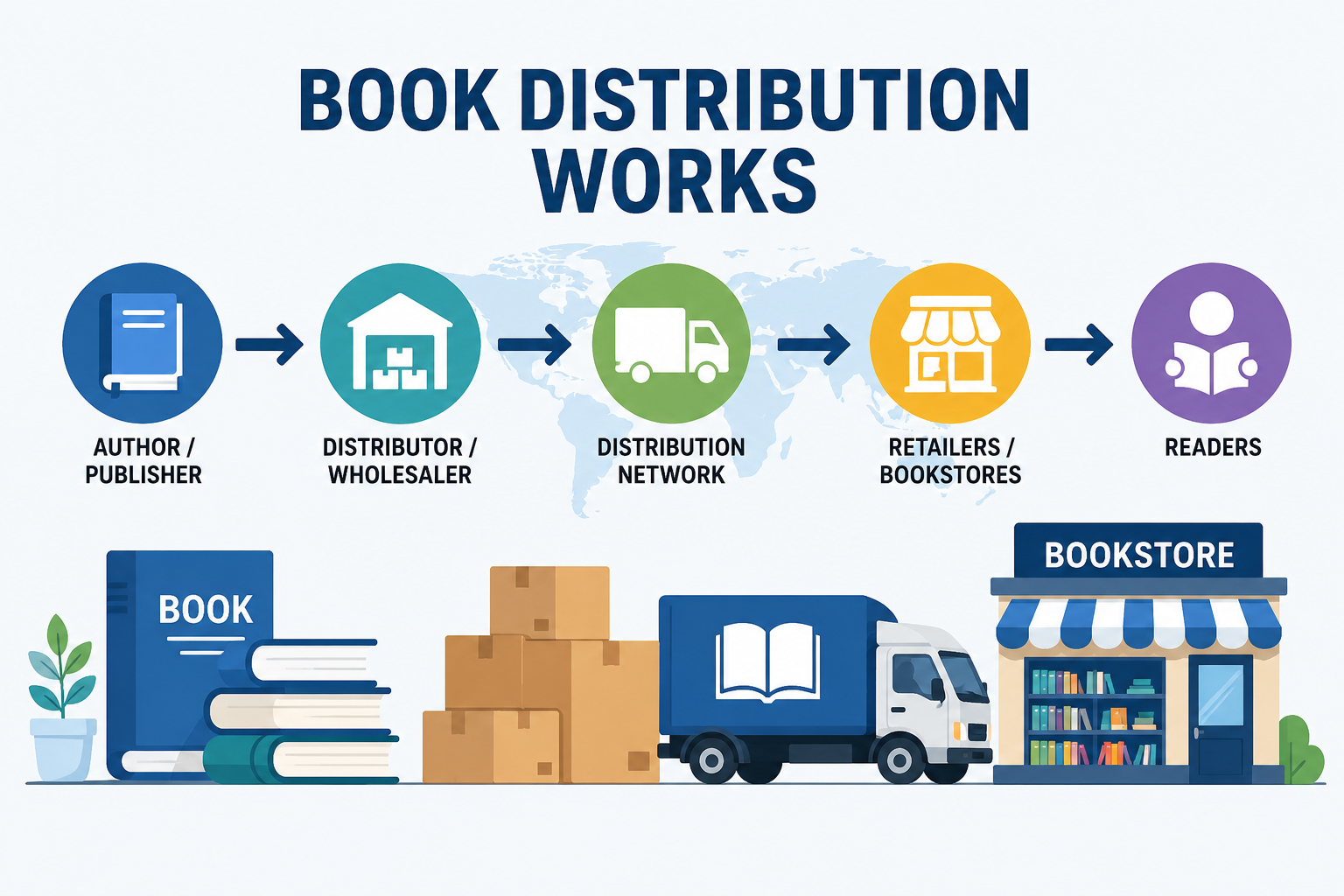
Writing and publishing a book is a major achievement, but publication alone does not guarantee that readers will find or buy it. One of the most important parts of a successful publishing journey is book distribution. Distribution determines how a book moves from the publisher or author to bookstores, online retailers, libraries, institutions, and ultimately readers.
For first-time authors, the book distribution process can appear complicated. Terms such as wholesalers, distributors, retailers, print-on-demand, metadata, ISBN, returns, and global distribution are often used without clear explanations. Understanding these concepts can help authors make better publishing decisions and improve their chances of reaching a wider audience.
This guide explains how book distribution works, the different distribution models available, and what authors should consider before choosing a strategy.
What Is Book Distribution?
Book distribution is the process of making a published book available through different sales and supply channels. These channels may include physical bookstores, online bookstores, libraries, educational institutions, specialty retailers, and international markets.
A distributor acts as a bridge between the publisher and the marketplace. Depending on the arrangement, a distributor may help make books available to wholesalers and retailers, manage orders, coordinate inventory, process shipments, handle invoicing, and support market access.
However, distribution does not automatically mean that a book will sell. Distribution creates availability, while marketing creates awareness and demand. Authors need both if they want sustainable results.
How Does the Book Distribution Process Work?
The distribution process usually begins after the book is professionally prepared for publication. The manuscript is edited, the cover is designed, the interior is formatted, and essential book information is finalized.
The book then needs accurate metadata. This includes the title, subtitle, author name, description, ISBN where applicable, publication date, format, price, categories, keywords, language, and other bibliographic information.
Once the book is entered into relevant distribution systems, retailers, wholesalers, libraries, or other buyers may be able to discover and order it according to the specific network and commercial arrangement.
For printed books, copies may be stored in a warehouse or produced through print-on-demand technology. For eBooks, digital files are delivered electronically through online platforms.
What Is the Role of a Book Distributor?
A book distributor helps connect publishers with commercial sales channels. Depending on the distributor’s services, it may manage relationships with retailers and wholesalers, process orders, coordinate fulfillment, manage inventory, and provide sales reporting.
For an independent author, accessing large numbers of retailers individually can be difficult. Distribution services can simplify this process by providing broader channel access through a centralized system.
However, authors should carefully review distribution fees, discounts, payment schedules, territory coverage, return policies, and contract terms before signing an agreement.
Distributor vs Wholesaler: What Is the Difference?
The terms distributor and wholesaler are sometimes used interchangeably, but they can perform different functions.
A wholesaler generally purchases or supplies books in volume and makes them available to retailers, libraries, and other buyers. Retailers can order books through the wholesaler rather than dealing directly with every individual publisher.
A distributor may provide a broader range of services. Depending on the business model, this can include warehousing, fulfillment, invoicing, sales representation, account management, and market access.
The exact distinction varies across markets and companies, so authors should evaluate the actual services offered rather than relying only on terminology.
What Is Retail Book Distribution?
Retail distribution focuses on making books available where consumers purchase them. This may include independent bookstores, chain bookstores, online retailers, specialty shops, museum stores, educational outlets, and other relevant sellers.
Physical bookstore placement can be challenging because shelf space is limited. Retailers consider factors such as expected demand, sales history, pricing, commercial terms, returnability, market relevance, and customer interest.
Simply having a book listed in a distribution database does not guarantee that physical bookstores will stock it on their shelves.
This distinction is important for authors. “Available to order” and “physically stocked in stores” are not the same thing.
How Online Book Distribution Works
Online distribution has significantly expanded opportunities for authors. A book can potentially reach readers far beyond the author’s local market without requiring placement in every physical bookstore.
Online retailers may sell printed books, eBooks, or both. Depending on the distribution setup, a printed book may be shipped from existing inventory or manufactured after an order is placed.
Online discoverability depends heavily on accurate metadata, competitive pricing, book descriptions, categories, keywords, cover design, reader reviews, and external marketing.
A book can technically be available online while remaining almost invisible to potential readers. Authors therefore need to treat discoverability as a separate strategic priority.
What Is Print-on-Demand Distribution?
Print-on-demand, commonly known as POD, is a publishing model in which a printed copy is produced after an order is received or according to the provider’s production workflow.
This approach can reduce the need for authors or publishers to invest in large print runs and maintain significant inventory.
For independent authors, POD can offer several advantages. It may reduce upfront printing risk, simplify fulfillment, and make it easier to keep a title available for longer periods.
However, authors should evaluate unit printing costs, production quality, delivery times, trim-size options, colour requirements, and distribution terms.
For some books, especially highly visual or premium publications, traditional offset printing may provide different cost or quality advantages at sufficient volume.
Traditional Print Distribution
Traditional print distribution often involves producing books in larger quantities and storing inventory in a warehouse or other fulfillment facility.
When retailers, wholesalers, or institutional buyers place orders, copies are shipped from existing stock.
This model can offer better unit economics at scale, depending on print volume and specifications. It may also be suitable for publishers expecting substantial demand.
The disadvantage is inventory risk. If sales are lower than expected, unsold copies can create storage costs and financial losses.
Authors and publishers should therefore estimate demand carefully before committing to a large print run.
How eBook Distribution Works
eBook distribution involves delivering digital book files to online reading and retail platforms. Unlike physical books, eBooks do not require conventional printing, warehousing, or physical shipping.
The author or publisher prepares the manuscript in an appropriate digital format and supplies required metadata, cover files, pricing information, and territorial settings.
eBook distribution can make international reach easier, but competition is intense. Strong metadata, professional cover design, appropriate categories, pricing strategy, reviews, and ongoing promotion remain important.
Digital availability should not be confused with digital visibility.
Why ISBN Matters in Book Distribution
An ISBN, or International Standard Book Number, is a unique identifier used for specific book editions and formats within the book trade.
Depending on the publishing market and distribution model, ISBNs can play an important role in cataloguing, ordering, inventory management, and bibliographic identification.
Different formats or editions may require separate identifiers under applicable ISBN rules. For example, a paperback edition and a hardcover edition may be treated separately.
Authors should verify current requirements with the appropriate ISBN agency or publishing service in their market.
What Is Book Metadata?
Book metadata is the structured information that describes a book. It is one of the most important components of modern distribution and discoverability.
Metadata can include the book title, subtitle, author name, publisher, ISBN, description, categories, keywords, publication date, language, format, page count, price, and contributor details.
Poor metadata can reduce visibility even when the book itself is excellent.
For example, an unclear title, weak description, inaccurate category, or incomplete author information can make it harder for retailers, search systems, and readers to understand the book.
Authors should treat metadata as a strategic marketing asset rather than an administrative formality.
Understanding Retail Discounts
In many book distribution arrangements, retailers and intermediaries receive a portion of the retail price. The exact commercial structure depends on the channel and agreement.
Suppose a book has a list price of ₹500. The full ₹500 does not necessarily go to the author or publisher. Retail discounts, distribution costs, printing expenses, taxes where applicable, returns, and other contractual deductions may affect the final amount.
Authors should understand the economics of each channel before setting a retail price.
A book can sell successfully while still generating weak margins if pricing and distribution costs are poorly planned.
What Are Book Returns?
Returns are an important part of traditional book retail economics in many markets. Under certain arrangements, retailers may be able to return eligible unsold books.
This can create financial risk for publishers and authors. A large initial order may appear positive, but if many copies are later returned, the actual sales outcome can be very different.
Authors considering returnable distribution should understand who bears the cost of returns, how returned copies are handled, and whether additional fees may apply.
The specific terms should be clearly documented in the distribution agreement.
Local vs Global Book Distribution
Local distribution focuses on a specific city, region, or country. It may be appropriate for books with strong geographic relevance, such as local history, regional travel guides, community publications, or books written for a specific language market.
Global distribution aims to make a book available across multiple countries or territories.
International reach can create valuable opportunities, but authors need to consider pricing, currency, shipping, territorial rights, taxes, language, local demand, and delivery times.
A global listing does not automatically create global sales. International marketing is still necessary.
How Libraries Fit Into Book Distribution
Libraries can be valuable channels for authors, particularly for educational, academic, professional, children’s, historical, and community-focused books.
Library acquisition processes vary significantly. Some libraries order through established suppliers, wholesalers, distributors, or specialized systems.
Authors interested in library reach should ensure that their books have professional metadata, clear bibliographic information, appropriate identifiers where required, and credible presentation.
Reviews and institutional relevance can also support library discoverability.
How Authors Can Choose the Right Distribution Strategy
There is no single distribution strategy that works for every book. The right approach depends on the author’s goals, budget, format, audience, market, and expected sales volume.
A local-interest book may benefit from direct partnerships with regional bookstores and organizations. A commercial novel may require strong online distribution and digital marketing. A professional business book may perform well through direct sales, events, corporate partnerships, and online channels.
Authors should identify where their target readers already discover and purchase books.
Distribution strategy should follow audience behaviour.
Common Book Distribution Mistakes Authors Should Avoid
One of the biggest mistakes is assuming that distribution automatically creates sales. Making a book available is only the first stage. Readers still need a reason to discover, trust, and purchase it.
Another mistake is using weak or incomplete metadata. Poor categories and descriptions can reduce discoverability.
Some authors also set prices without calculating printing costs, channel discounts, and other expenses. This can lead to unsustainable margins.
Other common problems include ordering excessive inventory, ignoring return policies, choosing unsuitable distribution channels, and launching without a marketing plan.
How Book Marketing Supports Distribution
Distribution and marketing work together. Distribution ensures that a book can be purchased, while marketing creates awareness and demand.
Effective book marketing may include author websites, search engine optimization, social media content, email campaigns, media outreach, book reviews, influencer partnerships, events, podcasts, advertising, and community engagement.
When readers begin searching for a title, retailers have stronger reasons to stock or promote it.
Authors should therefore plan marketing before publication rather than waiting until sales begin.
Why Work With a Professional Book Publication Company?
A professional book publication company can support authors through different stages of the publishing process, including manuscript preparation, editing, proofreading, cover design, formatting, metadata optimization, ISBN guidance, production, and distribution planning.
For new authors, professional support can reduce avoidable mistakes and provide a more structured path from manuscript to market.
However, authors should evaluate any publishing company carefully. Review its services, fees, distribution claims, rights terms, royalty structure, contract conditions, and level of transparency.
A reputable company should explain clearly what “distribution” means within its service package.
Final Thoughts
Book distribution is one of the most important components of a successful publishing strategy. It determines how and where readers can access a book, but availability alone does not guarantee commercial success.
Authors need to understand the roles of distributors, wholesalers, retailers, online platforms, print-on-demand services, libraries, and direct sales channels. They also need accurate metadata, sustainable pricing, professional presentation, and a strong marketing strategy.
The most effective approach is to design distribution around the target reader. Identify where your audience buys books, choose appropriate channels, understand the commercial terms, and actively build demand.
With the right combination of professional publishing, strategic distribution, and consistent marketing, authors can give their books a stronger opportunity to reach readers in local and global markets.