Publishing Contract Explained: Complete Guide for Authors
Understand book publishing contracts, including royalties, copyright, publishing rights, termination clauses, advances, and key terms every author should know before signing.
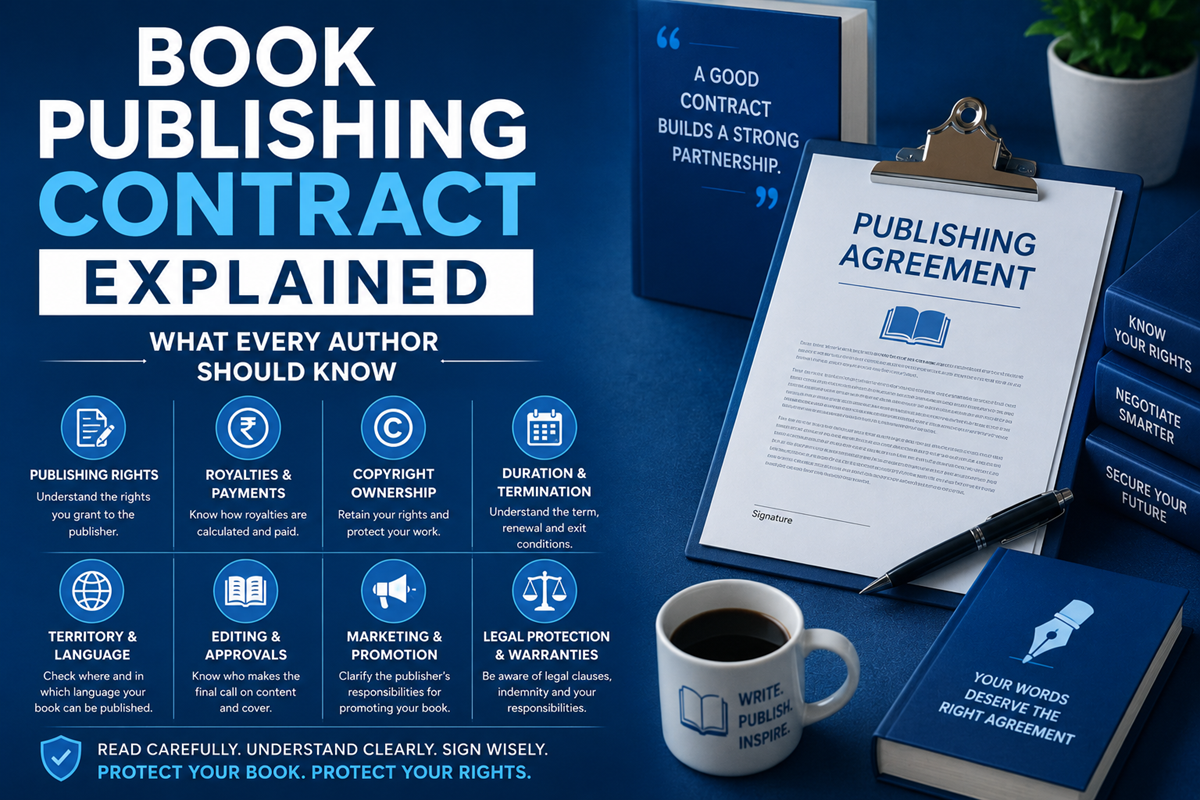
Getting an offer from a publisher can be an exciting moment for any author. After months or even years of writing, editing, and preparing a manuscript, receiving a publishing agreement may feel like the final step toward becoming a published author. However, signing a book publishing contract is a major legal and commercial decision that should never be rushed.
A book publishing contract defines the relationship between an author and a publisher. It explains which rights are being granted, how royalties will be calculated, who controls different formats, what responsibilities each party has, and under what conditions the agreement can end.
Whether you are a first-time author, an experienced writer, or planning to publish a book in India, understanding the main terms of a publishing agreement can help you make better decisions and protect the long-term value of your work.
What Is a Book Publishing Contract?
A book publishing contract is a formal agreement between an author or rights holder and a publisher. Under the agreement, the author typically grants the publisher specific rights to publish, distribute, market, or commercially exploit the book under defined conditions.
The exact structure of a publishing contract can vary significantly. Some agreements cover only a printed edition, while others may include eBooks, audiobooks, translations, international territories, adaptations, or additional subsidiary rights.
This is why authors should never assume that all publishing contracts are standard. Every clause can affect how the book is used and how the author earns income.
Why Is a Publishing Contract Important?
A publishing contract establishes the commercial and legal framework for the book. Without clear written terms, disagreements may arise regarding royalties, publication schedules, ownership, marketing responsibilities, pricing, distribution, or future editions.
For authors, the contract is especially important because a book can continue generating value for many years. A poorly understood agreement may restrict future opportunities, while a carefully reviewed agreement can create a clearer and more balanced professional relationship.
The contract should explain exactly what the publisher can do with the work and what rights remain with the author.
Understand the Grant of Rights Clause
The grant of rights clause is one of the most important sections of any book publishing contract. It defines which rights the author is giving to the publisher.
Authors should examine whether the agreement covers paperback publishing, hardcover publishing, digital editions, audiobooks, translations, foreign territories, adaptations, or other forms of commercial exploitation.
A broad grant of rights may give the publisher extensive control over the work. This is not automatically inappropriate, but the author should understand why each right is being requested and whether the publisher has a realistic plan and capability to use it.
Authors should avoid granting rights simply because they appear in a standard contract template.
Exclusive vs Non-Exclusive Publishing Rights
A publishing agreement may grant exclusive or non-exclusive rights.
Under an exclusive arrangement, the publisher may receive sole authority to exercise specified publishing rights during the contract period and within the agreed territory. This can prevent the author from granting the same rights to another publisher.
Under a non-exclusive arrangement, the author may retain greater flexibility to work with other parties, depending on the exact contract language.
The practical effect depends entirely on the wording of the agreement. Authors should understand the scope, duration, format, and territory of any exclusivity clause before signing.
Pay Attention to Copyright Ownership
Authors should clearly distinguish between copyright ownership and publishing rights. These concepts are related but not identical.
In many publishing arrangements, the author retains copyright ownership while granting the publisher specific rights through a licence. In other agreements, the contract may contain broader language affecting ownership or control.
Authors should carefully review any clause involving assignment, transfer, ownership, licensing, or control of intellectual property. A publishing deal should not be treated as a simple permission form.
If the wording is unclear, professional legal advice can be valuable before signing.
Understand the Royalty Structure
Royalties are a central part of a book publishing contract. The agreement should clearly explain how the author will be paid.
A royalty may be calculated using the retail or list price, net receipts, actual publisher revenue, or another defined basis. These methods can produce very different earnings even when the percentage appears similar.
For example, a royalty percentage based on net receipts cannot be evaluated properly unless the contract clearly defines what “net receipts” means. Authors should understand whether discounts, returns, taxes, commissions, distribution charges, or other deductions affect the calculation.
The percentage alone does not tell the full story. The calculation base is equally important.
Check the Royalty Payment Schedule
The contract should explain when royalty statements and payments will be issued. Depending on the agreement, reporting may occur at defined intervals.
Authors should examine how sales are recorded, how returns are handled, whether reserves are permitted, what information appears in royalty statements, and whether the author has any right to inspect or audit relevant records.
Transparent reporting is essential for a healthy author-publisher relationship.
Understand Advance Payments
Some traditional publishing agreements may offer an advance against future royalties. An advance is generally a payment made before sufficient royalties have been generated from book sales.
The contract should explain the amount, payment schedule, conditions, and relationship between the advance and future royalties.
Authors should understand that an advance against royalties is different from an additional royalty payment. Depending on the agreement, future royalties may first be applied against the advance before further royalty payments become payable.
Not every publishing model includes an advance.
Review the Territory Clause
The territory clause defines the geographic area in which the publisher can exercise the granted rights.
A contract may cover India, the Indian subcontinent, specific countries, particular language markets, or worldwide territories.
Authors should consider whether a publisher genuinely has the distribution capability to exploit broad territorial rights. Granting worldwide rights may have significant commercial consequences if the publisher has limited international reach.
Territory should be reviewed together with language rights, format rights, and distribution capabilities.
Check the Duration of the Agreement
Authors should understand how long the publishing contract remains in effect. Some agreements specify a fixed term, while others may continue based on publication status, sales activity, availability, or other contractual conditions.
A contract with a long duration can affect the author’s ability to work with other publishers or release new editions.
The agreement should also explain what happens when the term ends and whether rights automatically return to the author.
Understand the Publication Deadline
A publishing agreement should ideally provide clarity about when the publisher is expected to publish the book.
Without a meaningful publication obligation, an author may grant rights while the manuscript remains unpublished for an extended period.
Authors should review whether the contract includes a publication timeline, conditions for delay, and remedies if the publisher does not proceed with publication.
A clear publication framework can reduce uncertainty.
Examine the Rights Reversion Clause
Rights reversion is one of the most important long-term issues in a publishing contract. This clause explains when and how granted rights return to the author.
Reversion may depend on the expiry of the agreement, the book going out of print, sales falling below a defined threshold, failure to publish, termination, or other contractual conditions.
In the digital publishing era, the phrase “out of print” can become complicated because an eBook or print-on-demand edition may remain technically available for a long time. Authors should therefore pay close attention to objective reversion conditions.
Understand Editing and Manuscript Changes
Publishers often need the ability to edit manuscripts for grammar, clarity, consistency, formatting, market suitability, or production requirements.
However, authors should understand how much editorial control the publisher has. The agreement may address whether major changes require consultation or approval and how disagreements are handled.
This can be especially important for academic, technical, legal, medical, historical, or highly specialized works where changes may affect accuracy.
Check Cover Design and Title Control
The book cover and title can significantly influence sales, branding, and market positioning. Publishing contracts may give the publisher substantial control over design, packaging, title changes, and promotional presentation.
Authors should understand whether they have approval rights, consultation rights, or no final control.
A publisher may have legitimate commercial reasons for making design decisions, but the contract should make the decision-making structure clear.
Review Marketing and Promotion Commitments
Many authors assume that signing with a publisher guarantees extensive marketing. This is not always the case.
The contract may provide broad language about promotion without guaranteeing a specific advertising budget, number of campaigns, media appearances, bookstore placements, or launch events.
Authors should distinguish between general intentions and enforceable commitments. If specific promotional activities are important, they should be discussed clearly before signing.
Understand Author Copies and Discounted Copies
Publishing contracts often explain whether the author receives complimentary copies and whether additional copies can be purchased at a discount.
This can matter for book launches, speaking events, personal promotion, institutional sales, and direct outreach.
Authors should understand whether books purchased at an author discount generate royalties and whether restrictions apply to resale.
Check Warranties and Indemnity Clauses
A publishing agreement may require the author to make warranties about the manuscript. These may relate to originality, ownership, permissions, defamation, infringement, unlawful content, or third-party rights.
The contract may also contain indemnity provisions that allocate financial responsibility if legal claims arise.
These clauses can create significant legal exposure. Authors should not treat them as routine wording without understanding their practical consequences.
Understand Termination Conditions
A publishing contract should explain the circumstances under which either party can terminate the agreement.
Termination may relate to breach of contract, non-payment, failure to publish, insolvency, expiry of the term, or other specified events.
Authors should also examine what happens after termination. Important questions include whether rights automatically revert, whether existing inventory can continue to be sold, how outstanding royalties are handled, and whether digital listings remain active.
Be Careful With Subsidiary Rights
Subsidiary rights can include translation rights, audiobook rights, foreign-language rights, adaptation rights, serialization rights, merchandising rights, and other forms of exploitation.
These rights can become commercially valuable. Authors should understand which subsidiary rights are being granted and how income from licensing those rights will be shared.
A publisher requesting broad subsidiary rights should ideally have the capability to manage or license them effectively.
Watch for Hidden or Unexpected Costs
Authors should understand the financial model before signing. Traditional publishing, self-publishing, hybrid publishing, and assisted publishing can involve very different payment structures.
Some agreements may require the author to pay for editing, printing, marketing, distribution, packages, or additional services. If the author is paying substantial fees, the agreement should clearly explain what services will be provided.
Every payment obligation should be transparent.
Do Not Sign Under Pressure
Authors should be cautious if they are pushed to sign immediately without sufficient time to review the contract.
A publishing agreement can affect intellectual property rights and future income for years. Authors should read the complete document, ask questions about unclear clauses, compare promises with written terms, and seek qualified professional advice when appropriate.
Verbal assurances should not automatically be treated as substitutes for clear contractual language.
Should Authors Consult a Lawyer?
For contracts involving valuable rights, significant advances, broad territories, long terms, complex royalty structures, adaptation rights, or unclear legal language, consulting a qualified lawyer can be a sensible step.
Ideally, the professional should understand intellectual property, copyright, media, entertainment, or publishing contracts.
The cost of reviewing an agreement may be small compared with the long-term consequences of granting valuable rights under unfavorable terms.
Final Thoughts
A book publishing contract is more than a document that allows a publisher to print and sell a book. It defines rights, responsibilities, royalties, territories, formats, timelines, editorial control, marketing expectations, termination conditions, and the future commercial use of an author’s work.
Every author should understand the grant of rights, copyright provisions, exclusivity, royalty calculations, payment schedules, territory, contract duration, publication obligations, rights reversion, subsidiary rights, warranties, indemnities, and termination clauses before signing.
No two publishing agreements should be assumed to have the same effect. Authors should evaluate each contract according to its actual wording and their long-term publishing goals.
A successful publishing relationship begins with clear expectations, transparent terms, and a proper understanding of the agreement. When important rights or significant financial interests are involved, obtaining qualified legal advice before signing can help an author make a more informed decision.